


Hibbertia hypercoides
Yellow buttercups
This shrub grows up to one metre tall, flowering bright yellow from April to December. It is most prolific in Djilba and Kambarang, the season of yellow flowers, and can be seen in most areas of the Park.
H. hypercoides can be identified by the cup-like stamens paired with the dark green rounded leaves.


Hibbertia huegelii
A much smaller shrub than H. hypercoides, the H. huegelli is the next most common species found in Whiteman Park.
This species has a more open and prostrate growing habit. Getting to between 10-60 centimetres tall, the bright yellow flowers can be seen from July to December.
It is most prolific in Djilba and Kambarang, the season of yellow flowers, and can be seen in most areas of the Park. They can be identified by the five pairs of star-like stamens, five heart-shaped petals and hairy stepals. The long, needle-like leaves grow 30-40mm in length and have rolled edges.


Hibbertia subvaginata
Possibly the easiest of the Hibbertias to identify, H. subvaginata has blue-green leaves, unlike the rest of the species found in Whiteman Park. Their leaves also have a distinctive squared-off leaf, with a toothed tip.
This shrub grows from 15cm - 1.2m tall, flowering bright yellow from July to December. Like its cousins, it is most prolific in Djilba and Kambarang, the season of yellow flowers.
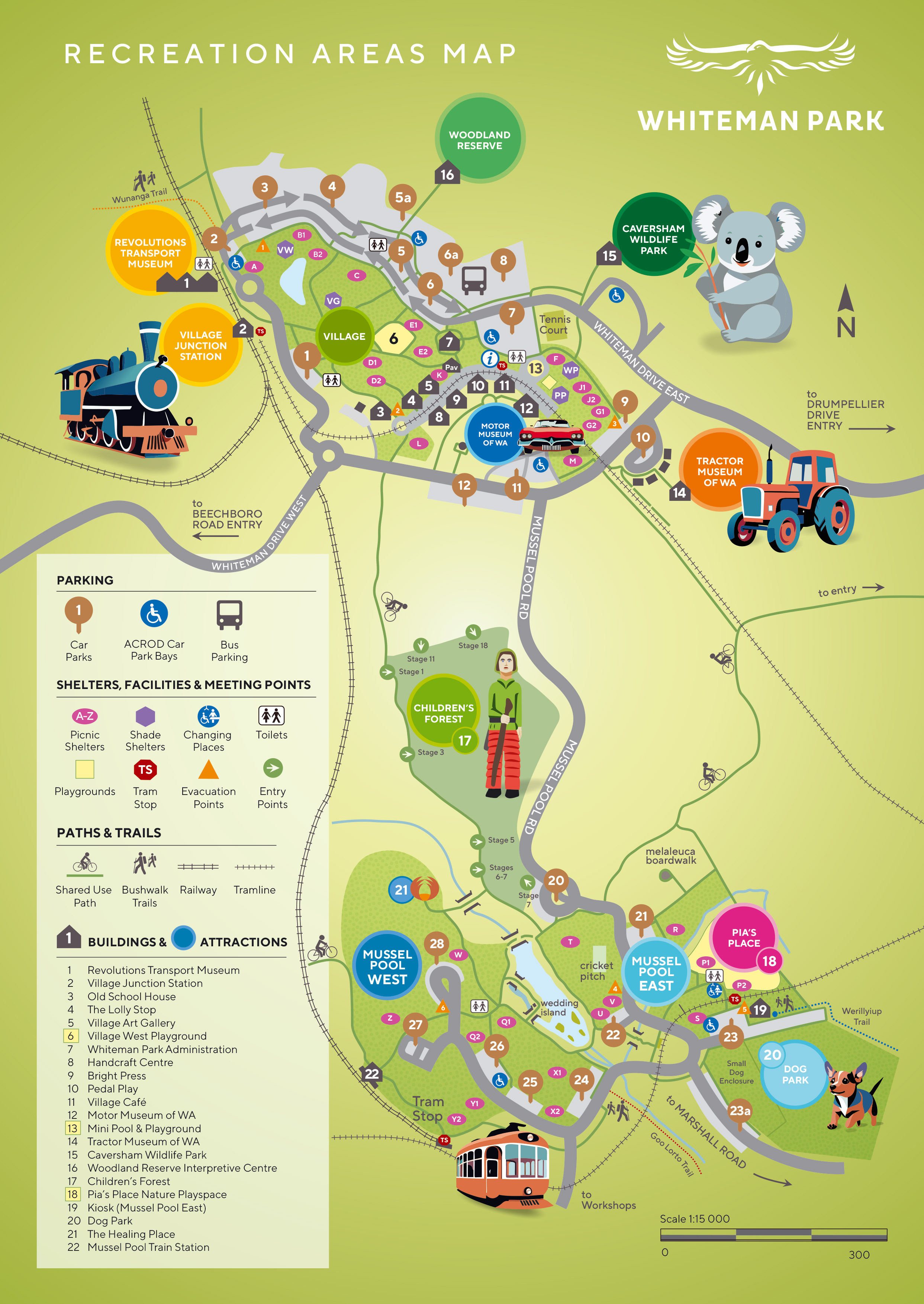
The Wunanga Trail and alongside Whiteman Drive West are good places to see this species.


Hibbertia racemosa
Stalked guinea flower
This species has the same squared-off, toothed leaf as H. subvaginata, although the leaves are dark green and this species has flowers that grow on stalks 8-30mm long.
This species has an erect and ascending growing habit that grows between 10-75 centimetres tall. The bright yellow flowers can be seen from July to December.
It is most prolific in Djilba and Kambarang, the season of yellow flowers, nearer to dampland areas.
References
- Judy Wheeler, Neville Marchant and Margaret Lewington. 2002. Flora of the South West: Bunbury - Augusta - Denmark. Australian Biological Resources Study and Western Australia Herbarium in association with University of Western Australia Press.
- Western Australian Herbarium (1998–). Florabase—the Western Australian flora. Department of Biodiversity, Conservation and Attractions. https://florabase.dbca.wa.gov.au/