

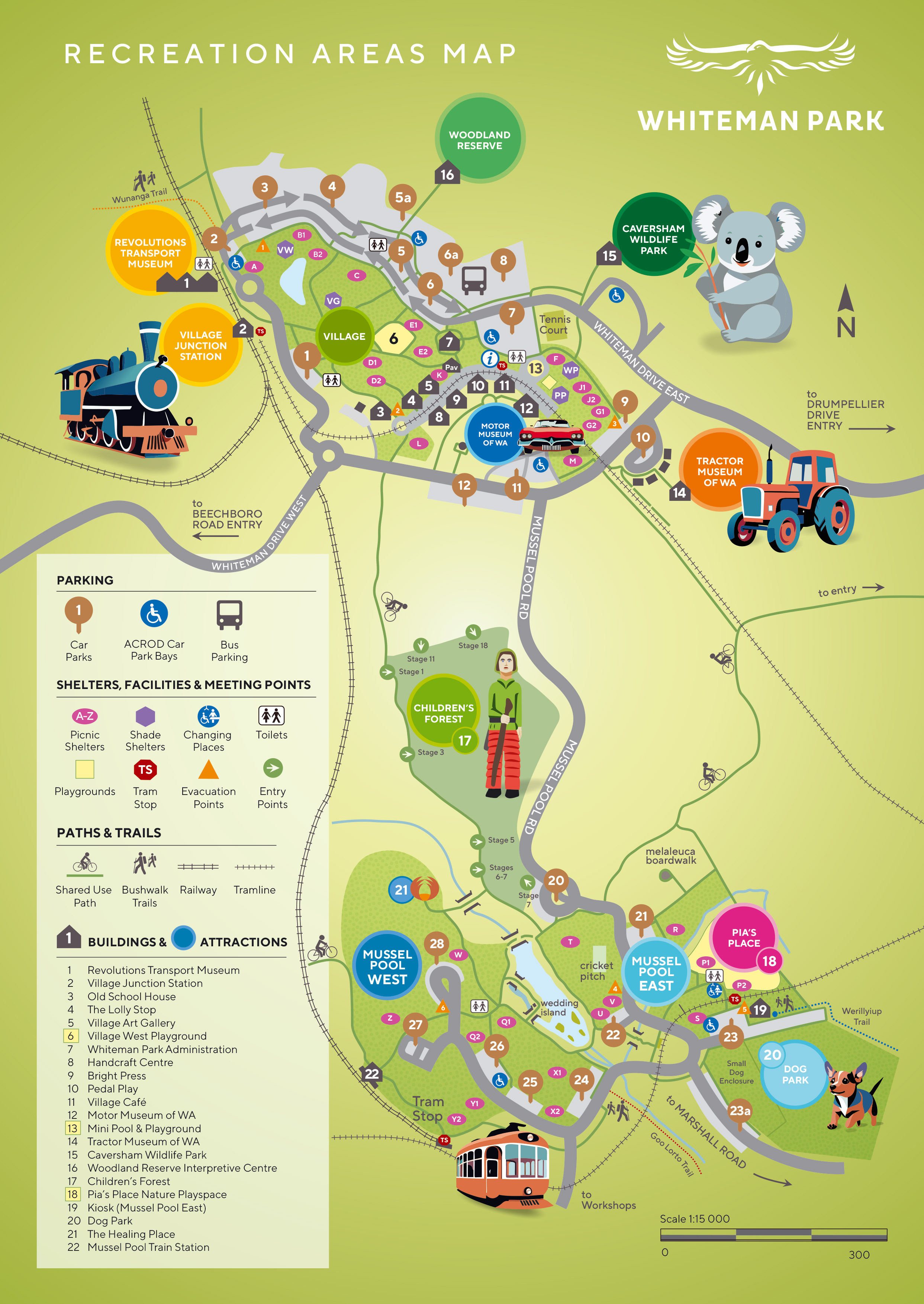


Village Tree Trail
Have you discovered the Village Tree Trail? Grab your map, then take a stroll to learn about some of our key tree species!
An iconic piece of Whiteman Park
The bulgalla (Banksia menziesii) is the most prolific of the five banksia tree species found in Whiteman Park.
Their showy red-toned inflorescences bloom from late summer to winter, making them a notable feature throughout the Park's banksia woodlands, particularly on Wunanga bush trail. You can also find an enchanting blush form of the firewood banksia, alongside less common yellow forms in the Children's Forest.
While we see these big flowering cones as a single 'flower', each cone is actually made up of hundreds of small flowers.
These Swan Coastal Plain natives are well-adapted to the nutrient-poor sandy soils of the Park and can be identified from its banksia relatives thanks to the breadknife-like serrations on the grey-green leaves.
Many birds, animals and insects rely on the flowers of the Banksia menziesii for survival, but the noolbenger (honey possum) may be the most unique, and sadly, the least likely to encounter. Most often, you will spot one of the many honeyeater species feasting on the nectar, as well as a host of pollinating insects.


SPECIES PROFILE
| Family | Proteaceae |
|---|---|
| Scientific name | Banksia menziesii |
| Noongar name | bulgalla |
| Common name | firewood banksia |
| Conservation status | Not threatened |
| Growth | tree or shrub, 1.3m - 7m |
| Flowers | pink to red or yellow, February to October |
Florabase profile


Dependant fauna
Nectar feeders like the tiny noolbenger, or honey possum, rely on these large flowering plants to survive.
Noolbenger