


Village Tree Trail
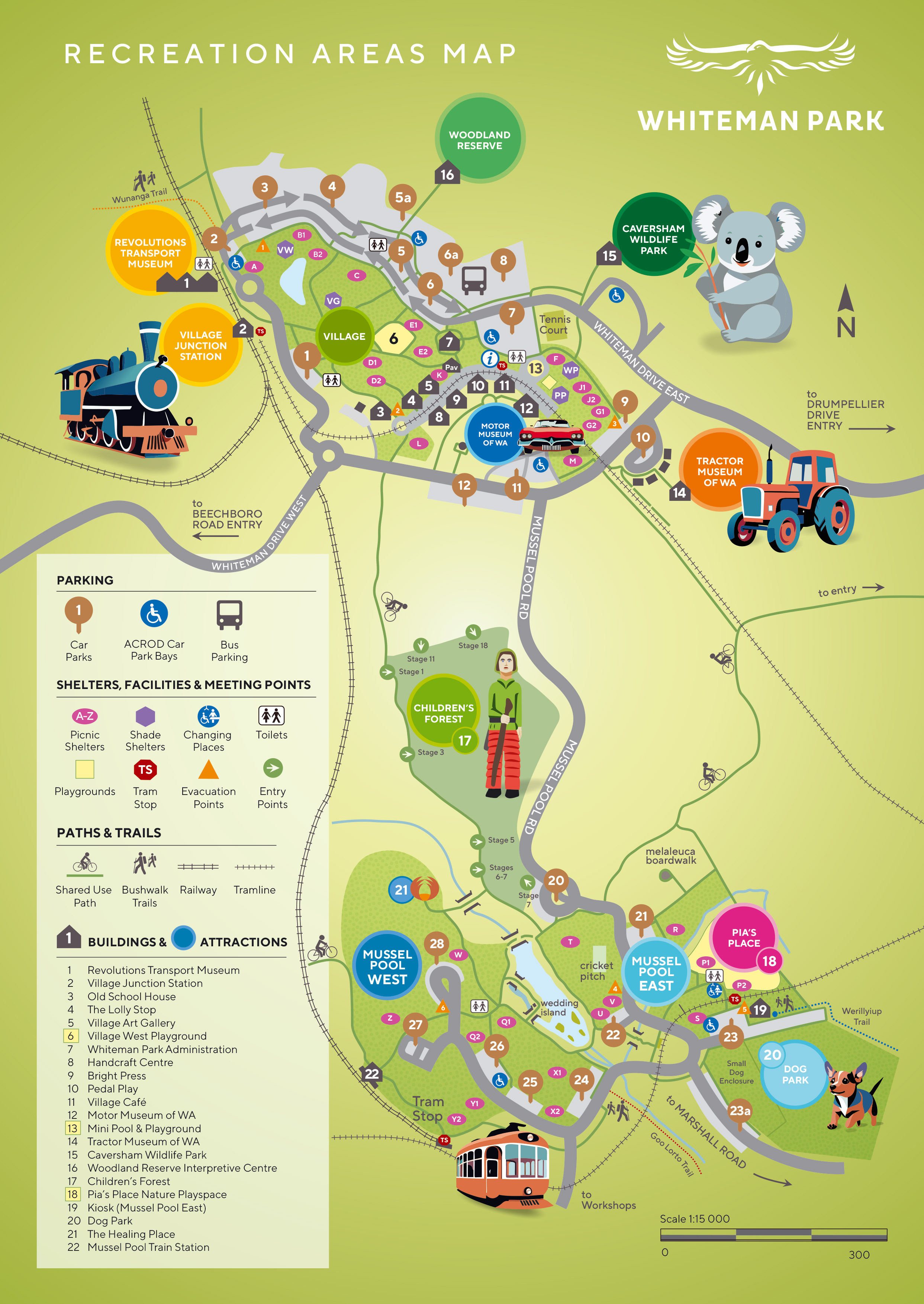
Have you discovered the Village Tree Trail? Grab your map, then take a stroll to learn about some of our key tree species!
An ecosystem giant
Marri trees are common throughout undisturbed areas on the Swan Coastal Plain and can be found in abundance in the Park. These, and older growth jarrahs, are the largest trees in Whiteman Park, growing to heights in excess of 25 metres and a girth of 1.5 metres.


The marri trees produce fruit commonly known as ‘honky nuts’ and are a favourite in the diet of the cockatoos and parrots that visit the Park.
The outer flesh protects the all-important seeds, both of which are much-loved by the karrak (forest red-tailed black-cockatoo) and ngoorlark (Carnaby's and Baudin's black-cockatoos).
Bursting into flower from December to May, the marri can bring a snow-capped look to our woodland canopy.
The flowers themselves are almost always a creamy white, but you can also find pink varietals - and very occasionally, something in between.


Interestingly, the marri used to be classified as a eucalypt alongside the other 'gum trees', but it was reclassified into the Corymbia family of bloodwood trees, so called for their red, gummy sap that can make the trees seem as if they are bleeding.
The marri can be distinguished from the jarrah by its tessellated bark and the fine parallel lines that run from stem to the outer leaf.
Like the jarrah and tuarts, habitat loss from land clearing has resulted in this grand species now being classed as Near Threatened by the International Union for Conservation of Nature (IUCN).


Species profile
| Family | Myrtaceae |
| Scientific name | Corymbia calophylla |
| Noongar name | marri |
| Common name | marri, red gum |
| Growth | tree, to 40m |
| Flowers | white/pink December to May |
| Conservation status | Near Threatened |
Florabase profile

